preschool-age
Children in the preschool-age range are generally defined as those who are three to five years old, a period marked by rapid cognitive, social, and emotional development. According to guidelines from the American Academy of Pediatrics, this stage lays the foundation for lifelong learning behaviors. Parents and educators often wonder what specific skills emerge during the preschool-age years and how best to support them.
Understanding preschool-age Developmental Milestones
Developmental experts from the National Association for the Education of Young Children outline three core domains for preschool-age learners: language acquisition, motor coordination, and social-emotional regulation. By age three, most children can follow two‑step directions, climb stairs with alternating feet, and engage in parallel play. At four, vocabulary expands to roughly 1,500 words, fine motor skills allow for scissor use, and cooperative play becomes common. Five‑year‑olds typically demonstrate early literacy awareness, can hop on one foot, and show improved impulse control.
| Age | Language Milestone | Motor Milestone | Social‑Emotional Milestone |
|---|---|---|---|
| 3 years | Uses 3‑word sentences; asks “why” questions | Runs steadily; pedals a tricycle | Shows affection to familiar peers; begins turn‑taking |
| 4 years | Speaks in full sentences; tells simple stories | Hops on one foot; draws a person with 2‑4 body parts | Engages in group play; expresses jealousy or pride verbally |
| 5 years | Recognizes letters and sounds; counts to 10 | Skips; cuts with scissors along a line | Shares without prompting; follows rules in games |
Effective preschool-age Learning Activities
Research from the Centers for Disease Control and Prevention highlights that purposeful play promotes neural plasticity during the preschool-age window. Activities that blend movement, language, and problem‑solving yield the strongest gains in executive function. Below is a curated list of evidence‑based practices that teachers and caregivers can implement with minimal resources.
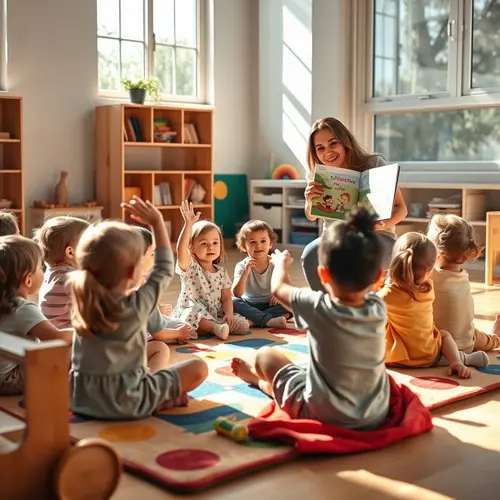
- Interactive read‑alouds with open‑ended questions to boost vocabulary and narrative skills.
- Obstacle courses using cushions and tunnels to develop gross motor coordination and spatial awareness.
- Sorting games with colored beads or shapes to strengthen categorization and fine motor precision.
- Role‑play scenarios (e.g., grocery store, doctor’s office) that encourage perspective‑taking and language use.
- Music‑and‑movement circles that incorporate rhythm sticks to support auditory processing and self‑regulation.
An illustrative case study involves a four‑year‑old named Maya who exhibited reluctance to join circle time. Her teacher introduced a short “music‑move” segment before the story, allowing Maya to release excess energy through structured dance. Within two weeks, Maya’s participation increased, and her teacher noted improved attention during subsequent literacy activities. This example underscores how aligning activities with a child’s sensory needs can transform engagement.
Expert insight from Dr. Patricia K. Kuhl, co‑director of the Institute for Learning & Brain Sciences, emphasizes that the preschool-age brain is uniquely receptive to social interaction. She notes that “the timing of exposure to rich linguistic environments predicts later reading success more strongly than any solitary factor.” Leveraging this sensitivity through responsive caregiving and peer‑based play yields measurable long‑term benefits.
In summary, recognizing the distinct milestones of the preschool-age period empowers caregivers to select interventions that match developmental readiness. By integrating evidence‑based play strategies, monitoring progress against established benchmarks, and staying attuned to individual temperaments, adults can nurture a resilient foundation for lifelong learning.
About the Author